
The road to a data-driven organisation

Written by Barry Eichhorn
Owner & AI Advisor
We all know it: you are on holiday, looking at something, and decide to take out your phone because it is worth capturing. You take a photo, which then disappears into your phone among thousands of other photos and videos. The photo can be stored on your phone's internal memory or on an external source such as the cloud. You have just created and stored a piece of data that in 99% of cases will never be looked at again. In the past 2 years, more data has been created than in the entire history of humankind. The expectation is that by 2025 the total amount of data created on earth will have risen to 163 zettabytes (ZB), which is equal to 163 sextillion bytes. Together we create gigantic amounts of data. It can therefore be said that we have no problems creating data; in fact, we are quite good at it. Yet an interesting fact is that we use or analyse only 0.5% of all data. In this blog, more about how you work towards a more data-driven approach.
"Why do we create data and store it somewhere if we hardly do anything with it?"


Data?
In business, the word 'data' is all the rage. You hear it coming from all sides. Terms such as big data, data silos, data analysts, data sources and data management platform are flying around. Despite the 'data hype', for many organisations there are more questions than answers when it comes to their data challenge. In this blog we put the word 'data' under a magnifying glass. How come many organisations struggle to analyse and use data? What first steps are needed to become a more data-driven organisation?
Of course, it is not the case that all data has to be continuously analysed and used. But there is certainly data from which interesting insights can be drawn. For organisations in particular, analysing and using data can support and steer processes and decisions. But before we go into which data organisations can use, it is important to first give a proper meaning to the word 'data'. The Cambridge Dictionary gives us two meanings of the word 'data':
1. “information, especially facts or numbers, collected to be examined and considered and used to help decision-making”
2. “information in an electronic form that can be stored and used by a computer”
The definition of the word 'data' that we use here is: data is information in a digital form that can be analysed and used in decision-making. Now that we know this, we can look at what type of data you can use as an organisation.

Data types within an organisation
When an organisation wants to start working with data, an important first step is mapping out the different types of data it has at its disposal. There are many different types of data within organisations, and this differs for every organisation. Most data can be summarised in 5 different data types.
1. Master data: The most important data an organisation has. Master data includes customer data (name, age, gender), data from external or internal parties such as suppliers or employees, but also product data. Departments within an organisation often have their own master data. An example is an HR department that creates, stores and maintains data on employees. That is the master data of that department and is usually stored in, and can be found in, the systems the HR department uses.
2. Transactional data: This is data that comes from important business activities. An example of transactional data is data generated during production activities or organisational activities such as hiring and dismissing employees. Companies often have a lot of transactional data because many business activities take place every day, and so a lot of data is added.
3. Reference data: This is data that can be regarded as standard and is an offshoot of master data. We are talking here about data that is fixed, such as the country or countries where the business activities take place. As an organisation you know that the country is not just going to change. It is important to map out this data type because this data provides structure in the entire data process. Distinguishing between data that is fixed and data that can change is part of a data-driven approach.
4. Reporting data: This is data on which analyses can be run. Obtaining the right reporting data often only happens at the end of the process. Once an organisation has mapped out which data it can use to extract valuable insights, it can start making analyses. Reporting data is often used for decision-making.
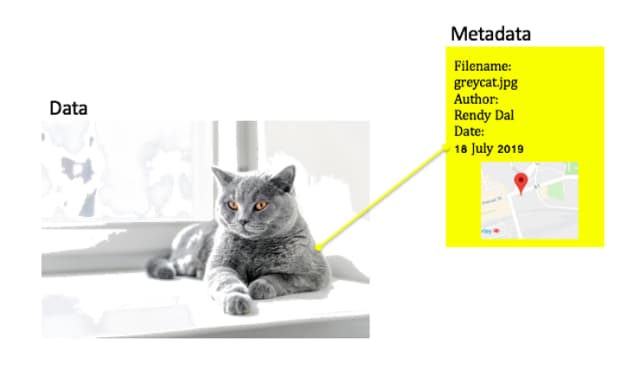
5. Metadata: Finally, there is metadata. This is the data about the data. That may sound strange, but some data has underlying data of its own. To clarify this, an image is shown below. The image of the cat is data in itself, but behind this image there is also metadata that tells you more about the image. This data can be valuable for organisations.
The first 'data steps'
Many organisations don't know where to start when it comes to using data. This is logical, because data management is often large and complex. It is therefore always a good idea to give people within or outside the organisation the time to get started with data management. An important first step is, as described above, mapping out the different types of data the organisation has at its disposal. While mapping this out, it immediately becomes clear where (in what kind of systems) the data is located. Ultimately, the end goal is to get a dataset somewhere on which analyses can be run to support or adjust decision-making.
A well-known example of an analysis tool that most people know is Google Analytics. Valuable insights about an organisation's website can be drawn from this platform. Of course, this is by no means all the data within an organisation, but it is often already a first and relatively easy step towards doing something with data.
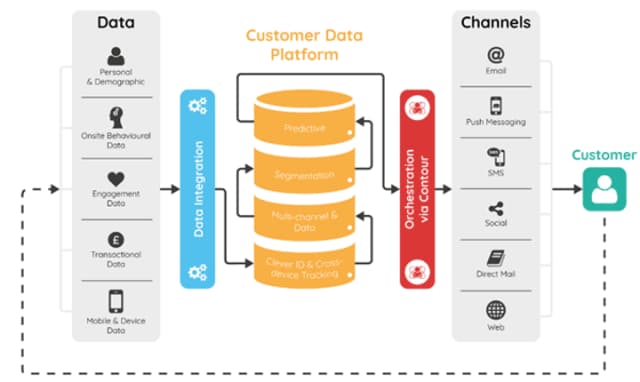
Of course, there are many more technologies and tools that can support the road to a data-driven organisation. Marketing technologies include, for example, marketing platforms, marketing suites and the increasingly used Customer Data Platforms (CDP) or Data Management Platforms (DMP). These latter platforms already give organisations a much better insight into their data and are particularly important for linking different data sources and datasets together.
Digital mindset
If we look at companies that base decision-making on data, they all have one thing in common: a digital mindset. When we talk about digital mindset, 3 types of organisation can be distinguished:
Type 1: Organisations that think it will all blow over. Things are going well now, aren't they? Why would we change something that is going well?
Type 2: Organisations that do want to change but don't understand how. This is probably the largest group of organisations, and often a combination of digital awareness and external help is the solution for being able to take the first steps.
Type 3: Organisations that get it. These are the market disruptors and often still young organisations where the digital strategy is the most important part of the business strategy.
"What would it mean for your organisation to become a type 3 organisation?"
The road to a more data-driven approach and setting up a digital strategy is not a sprint but rather a marathon. It is certainly not an easy process either. An important tip is: start small. Many organisations want to tackle digitalisation across the whole organisation at once, which makes it such a large and complex project that nobody has an overview any more, and in the end nothing happens and it gets shelved. By first getting started within one department with a particular set of data, the first steps towards a more data-driven approach can already be taken. The marketing department is often the forerunner because that is where the most data is available. When a digital mindset prevails in one department, the other departments will follow more quickly. It is also the case that working in a data-driven way has more impact for one department than for others. For that reason it is better to start with the departments where the expected impact is greatest. With a higher expected impact, it is easier to develop a digital mindset.

The digital revolution
The digital revolution is here and is characterised by a large number of new technologies, including: artificial intelligence, Internet of Things, big data, blockchain, virtual and augmented reality, data warehousing. The revolution brings new ways of working. Using the technologies and platforms smartly offers interesting possibilities. A good example of this is Social Selling where social media channels are used throughout the entire sales process to significantly increase revenue and margin.
We are only at the eve of the digital revolution, and its impact will be comparable to that of the industrial revolution. Many organisations will not be able to transform themselves quickly enough because they keep clinging to their current business model. Organisations earn a lot of money with their current business model and don't want to undermine it. But if established organisations don't innovate in time, other companies will do it for them.
For organisations, the digital revolution brings unprecedented opportunities, and a more data-driven approach is needed to avoid falling behind. Applying data analyses and predictive algorithms on a large scale helps organisations to operate at a much higher level. It is therefore crucial for an organisation to develop a digital strategy and work towards a data-driven approach. This does, however, require digital awareness.
If your organisation still thinks that a more data-driven approach is not important, ask your boss this question: where are you going to work in 5 years when our organisation no longer exists?
Start accelerating your online growth today!