
AI
C2N brings structure to the use of AI across the whole organisation
Company: C2N


meet:
C2N
C2N is a consultancy specialising in sustainable real estate. From their office in The
Hague, they support clients in improving the performance of their
property, through BREEAM and LEED certification, Technical Due Diligence, EPA advice, EU
Taxonomy and project management. Their clients are institutional investors, developers,
asset managers, governments and contractors who set the bar high for
sustainability and quality.
BE Digital has been working with C2N as a partner for quite some time. We support them with
LinkedIn advertising, Google Ads, SEO and website optimisation, with the aim of
reaching the right target audience and generating quality leads for their range of services.
In addition to this ongoing collaboration, we carried out a standalone
AI implementation project for C2N. In this project, we integrated Claude, Anthropic's AI assistant,
into the team's daily way of working. Not as a replacement for
subject-matter expertise, but as a supporting tool for recurring and
knowledge-intensive work. Think of structuring and processing information,
preparing documents, creating first drafts and processing
meeting minutes. This way, AI helps employees work more efficiently, while the substantive
assessment and responsibility remain with C2N.
The result is an organisation that works smarter, spends less time on recurring
tasks and has more time left for what really matters: advising their
clients.
Company
C2N
Services
AI-driven landing page
Websites
www.ditisfeller.nl
www.werkenbijfeller.nl

the challenge
Almost every organisation is now at the same stage. One person works with ChatGPT, the
other with Claude, someone has installed Copilot and another colleague isn't really doing
anything with it yet. Everyone discovers AI in their own way, but that is exactly what creates
something else. There is no shared way of working, nobody knows exactly which tools are safe,
and good ideas often stay with the employee who happened to discover them.
other with Claude, someone has installed Copilot and another colleague isn't really doing
anything with it yet. Everyone discovers AI in their own way, but that is exactly what creates
something else. There is no shared way of working, nobody knows exactly which tools are safe,
and good ideas often stay with the employee who happened to discover them.
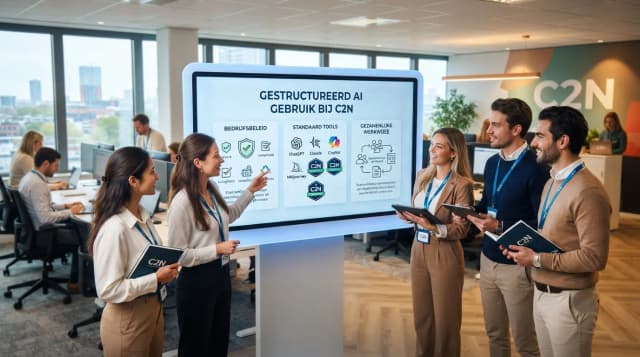
That was exactly the situation we encountered at C2N. There was already plenty of experimenting with AI within the organisation, not because agreements had been made about it, but because employees saw for themselves that AI could help them in their daily work. But everyone used different programs, different accounts and their own way of working. For C2N, that was the moment to go a step further, not by holding AI back, but by turning it into a safe and clear way of working.:

our solution
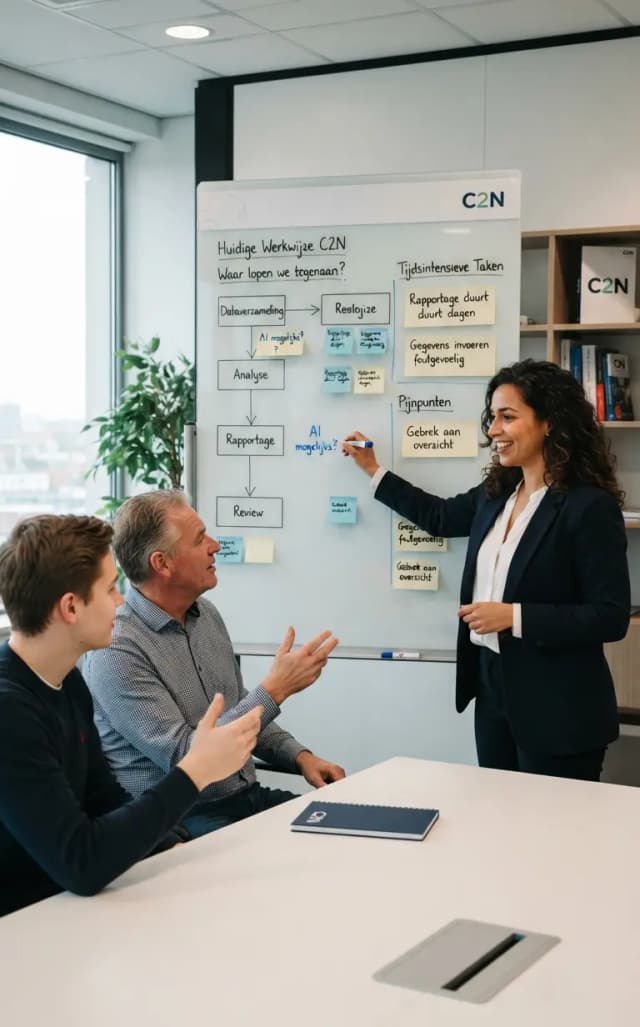
If there is one thing we believe in, it's that a good AI implementation doesn't start with the choice of a platform. That's why we didn't start with a demonstration of Claude or a comparison between different tools. We first wanted to understand how employees work. Which tasks take a lot of time, what do people run into again and again every week, and at which moments can AI really add something.
To get a good picture of this, we didn't simply send round a
questionnaire. Every employee had a conversation with an AI agent that asked questions about
their daily work, recurring tasks and expectations around AI, and
asked follow-up questions where needed. The agent recorded the answers in a structured way and
shared the outcomes with us. This gave us a concrete picture, per employee and across the organisation
as a whole, of where the biggest opportunities lay. Sometimes the gain was in
processing information more smartly, sometimes in supporting recurring
tasks or making knowledge more accessible. It was precisely these differences that made
clear that one general solution would not be enough.
Not the prettiest tool, but the right tool
Only then did we start looking at which solution fitted best. After comparing
different platforms, we chose Claude from Anthropic, not because there is one
perfect solution for AI, but because at that moment Claude best matched
the way C2N works. We looked not only at how well the
platform handles complex information, but also at ease of use, business
management options and the way company data is handled.
Because C2N works in Microsoft 365 every day, we then explored how
Claude could become as natural a part of it as possible. In the end, we made sure
that employees can use Claude directly from Word, Excel and
PowerPoint, without constantly having to switch between different programs.
What we often see in practice is that organisations give employees access to AI and
expect everyone to figure out by themselves how best to use it. We
deliberately took a different approach. Based on the inventory, we set up six
different environments, each tailored to the work within C2N.
We also developed various skills for recurring tasks, such as
supporting document analysis, writing up reports and structuring
information. As a result, an employee doesn't start from a blank screen every time:
context, instructions and ways of working are set up in advance for common tasks. The
employee remains in charge of how the output is assessed and used.
A platform has little value if employees don't know how to use it in their daily work. That's why we concluded the project with an on-site training day, not only to explain how Claude works, but above all to discover together how AI becomes part of daily work. We showed how the configured environments work, how employees can collaborate with Claude from Microsoft 365 and how to give AI good instructions. At the same time, we paid a lot of attention to something that is at least as important: staying critical of the output. AI can phrase things very convincingly, even when an assumption is wrong. That's why the substantive check always remains with the employee.
An assistant that fits the work
We work with, among others:








the result
C2N now has one central environment for AI, tailored to daily practice,
integrated into Microsoft 365 and supported by custom skills. As a result,
employees no longer have to work out for themselves which tool to use or how to make the best
use of it, and colleagues who previously all found their own way now work together more
consistently. AI is no longer a standalone application, but a practical tool that has
become part of the daily way of working. The expertise, substantive
assessment and responsibility always remain with C2N's employees.
As Edwin van Eeckhoven, owner of C2N, puts it: “The AI project with BE
Digital has helped us enormously to make AI a real part of our daily
way of working. The environment and skills match what we need well, and
thanks to the practical training, our employees can get started right away. We are
enthusiastic about the possibilities and look forward to continuing to build
on this together.”
The BE Digital Touch
What this case study mainly shows is that successful AI adoption is far less about technology
than is often thought. We believe you can only decide which tool suits an
organisation once you first understand how people work, where time is lost and where AI
can genuinely help. That's why we don't start with a ready-made demo,
but with research into the work itself. Only then do we choose and set up the technology.
At C2N, that meant one central environment, various skills, integration with Microsoft
365, practical training and clear agreements on usage. AI supports
craftsmanship, but doesn't replace it. We bring that down-to-earth approach to every
AI project.
Curious what a similar approach could mean for your organisation? Feel free to
get in touch, we'd be happy to think along with you.